Embedded Electronics and Their Role in Modern Tire Technology
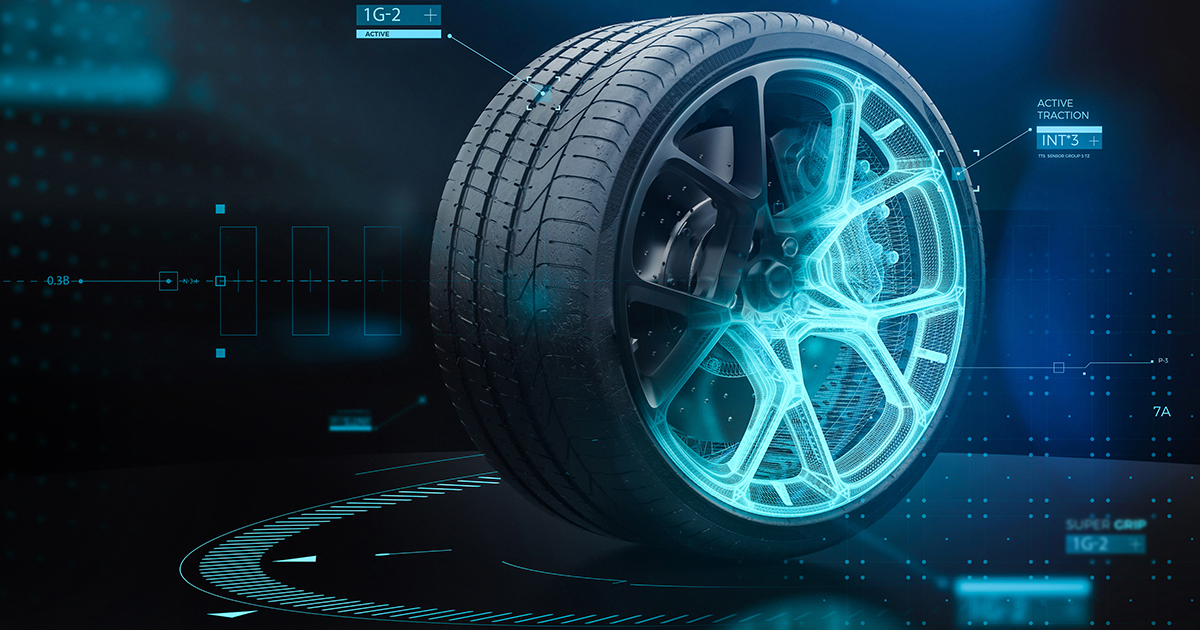
Automotive tires have been the first-place engineers and OEMs look at to control the vehicle. The ability to transfer kinetic energy from the drive axle to the road to propel the vehicle is the driving force of transportation. Throughout the years, OEMs have worked on tire technology to increase their adhesion and minimize wheel slip. This has been developed from the tire standpoint; new rubber polymers, tire construction and size. They have also worked on this from the suspension standpoint; moving weight to the different corners of the vehicle, ABS and other traction control devices. Keeping control in the drivers’ hands requires controlling the vehicles Kinetic energy and keeping it pointed in the correct direction. Everything from the natural rubber to the synthetic polymers that are used to construct the tire, the ability to resist the forces of time, temperature and pressure is a modern marvel of engineering. The abuse a driver puts the tire through by hitting items in the roadway, to the roadway itself falling apart, the tire has the ability to resist the abuse. Change requires an understanding of what are the new materials that are being brought into the mix and how those items will react to the world the actual tire lives in. The industry is moving towards a more embedded feature rich tire that allows the vehicle to understand exactly how the tire is reacting to the environmental conditions. Intelligent tires are pioneering a new area of development for the OEM and how the vehicle handles.
What Do Tires Tell Us?
To appreciate this transition, we must first understand the evolution. First, it was just a visual wear bar that was embedded in the tire that you can utilize to determine if the tread was getting too low. You could also use the penny trick; if the tread covered part of Lincoln’s head, you still had enough tread to run the tires. A tire gauge and visual inspection went a long way to determine the health of the tire. Those options still work to this day, though with the lack of training the driver to actively evaluate their vehicle, their technical abilities are not once they used to be.
Around the late 90’s we started measuring tire pressure through the Tire Pressure Monitoring Systems (TPMS). Whether it was indirect (ABS sensor input) or direct (sensor in the tire), the driver started to get more information on the actual air pressure in each tire. This provided real time insights into a potential issue before it became an issue on the road. By monitoring or alerting the driver they have the ability to pull over and have the tire reinflated or at least evaluated for its operation. This has helped minimize possible collision events based on low or flat tires as it alerts the driver to the issue before they continue on their path. The physical condition of the tire still needs to be evaluated periodically; this has been incorporated into most oil service procedures at most repair facilities. With oil life messages on the instrument panel displaying percentage of oil life left, the training of the repair facility has also helped to mitigate any tire issues. At minimum, bringing it to the attention of the driver so they can adjust their driving style.
Electric Vehicles (EV) do not have the same maintenance schedule, so the tires do not get evaluated as much as a conventionally powered vehicle. Without this continuous evaluation, the possibility of a worn-out tire continuing in service increases. This is a great use case for the new intelligent tire.
How Intelligent Tires Function
An "intelligent tire" contains a small, robust, self-powered sensor package that is physically bonded to the tire's inner liner during the manufacturing process. It becomes an integral part of the tire's structure, designed to last the life of the tread. This "cured-in" approach is what makes it so powerful; it's protected from the elements, damage, and installation errors. In this sensor package there are strain gauges, temperature sensors, wireless antennas, and piezoelectric energy generators. As the tire moves, the mechanical stress of the moving tire excites the piezoelectric generator and it creates power for the sensor array to operate (Yunta et al., 2018). The amount of power is very minimal but enough to transmit the information to the vehicles control unit so it can use it in the operation of the vehicle.
When the control unit receives this information, it can adjust braking schemes, suspension loading and propulsion power ramps to provide an optimal operational situation for the driver of the vehicle. With the ability to generate its own power, the sensor array should never run out of power and work for the life of the tire.
Integrated Tire Technology
Companies like Goodyear with its SightLine technology, Pirelli with its Cyber Tyre, and Michelin with its connected solutions are at the forefront, turning decades of tire manufacturing expertise into a new digital frontier (Goodyear, 2025; Pirelli, 2025). This integrated tire technology can help to prevent blowouts by alerting the driver to the changing composition of the tire, along with providing information on real time hydroplaning and ice detection. Determining how much ice/water is between the tire and roadway can alert the stability control systems to start regaining control of tire rotation before it becomes an issue for the driver. The key to maintaining vehicle control is keeping the tire from skidding across the roadway and overcoming the friction coefficient of the tire to the roadway. Prior to this technology, Antilock braking systems (ABS) was implemented to maintain vehicle tire rotation, understanding the environmental factors outside of the vehicle’s mechanical components will allow the system to adapt better to the situation and keep the vehicle moving in the right direction.
As the driver applies the brakes in a braking event, the vehicle’s kinetic energy is continually trying to overcome the ability of the pad and rotor to convert that energy into thermal energy. In some situations, the kinetic energy is so great that the conversion event is overcome, and the vehicle enters an uncontrollable state. This state is usually a low/no traction event. In this situation, the ability to control the vehicle is no longer in the hands of the vehicle and physics takes over. The systems present on the vehicle are trying to prevent this event from the moment the ignition is switched into the running position, and the vehicle is moving. Adding these “other” sensors providing information into the sensor fusion strategy will add more information to the ECU’s decision process to help make informed split-second conclusions on vehicle operation. Providing this increased information will also help to prolong the life of the tire as it will help manage the wear to make sure the tire is being worn properly and alert the driver if a situation arises where it could be increased wear. By maintaining the tire integrity, the fuel mileage (EV range) will increase as the tires will be maintained at optimal pressures and increasingly be put in optimized situations.
Conclusion
The integration of embedded electronics is fundamentally transforming the tire from a passive component into an active, intelligent, and communicative data hub. Since the invention of the tire, the ability to remotely monitor the situation within the tire has not been possible. The migration to TPMS to help the driver keep an eye on the tire pressures was a helpful addition, but so much more was missing in helping the vehicle make informed decisions based on what is occurring in real time with the tires. Intelligent tires are one of the final pieces of the puzzle in creating a vehicle that is truly aware of its environment. This tire revolution is happening right now inside the wheel wells of a growing number of vehicles; it is making our roads safer, our transportation more efficient, and our autonomous future more realistic. The ability to see this information in real time also allows the driver to increase the longevity of the tire as the constant.
The MAST series of CDX Learning Systems provides the instructor with pointed material to exceed the requirements of any ASE training currently on the market. Utilizing the Read-See-Do model throughout the series, the student has various learning modalities present throughout the products which allow them to pick the way they learn the best. From developing simulations on cutting edge topics to providing a depth of automotive technical background, CDX has a commitment to making sure instructors and students have the relevant training material to further hone their skill sets within the mechanical, electrical and software driven repair industry. CDX Learning Systems offers a growing library of automotive content that brings highly technical content to the classroom to keep you and your students up to date on what is currently happening within the Mobility Industry. Check out our Light Duty Hybrid and Electric Vehicles, along with our complete catalog Here.
About the Author
Nicholas Goodnight, PhD is an Advanced Level Certified ASE Master Automotive and Truck Technician and an Instructor at Ivy Tech Community College. With over 25 years of industry experience, he brings his passion and expertise to teaching college students the workplace skills they need on the job. For the last several years, Dr. Goodnight has taught in his local community of Fort Wayne and enjoys helping others succeed in their desire to become automotive technicians. He is also the author of many CDX Learning Systems textbooks, including Light Duty Hybrid and Electric Vehicles (2023), Automotive Engine Performance (2020), Automotive Braking Systems (2019), and Automotive Engine Repair (2018).
Related Content
Automotive Night Vision and Thermal Sensing: An Introduction to Advanced Technology
How Connected Vehicles Are Reshaping the Automotive Industry
The Influence of AI on the Future of Automotive Technology Development
References
Goodyear. (2025, August 31). Goodyear Sightline. https://www.goodyearsightline.com/automakers-suppliers
Pirelli. (2025, August 31). Pirelli Cyber Tyre. https://www.pirelli.com/tires/en-us/car/tech-and-knowledge/cyber-tire
Yunta, J., Garcia-Pozuelo, D., Diaz, V., & Olatunbosun, O. (2018). A strain-based method to detect tires’ loss of grip and estimate lateral friction coefficient from experimental data by fuzzy logic for intelligent tire development. Sensors (Switzerland), 18(2). https://doi.org/10.3390/s18020490