Your Next Diagnostic Tech Is a Model: How Large Language Models Read a DTC
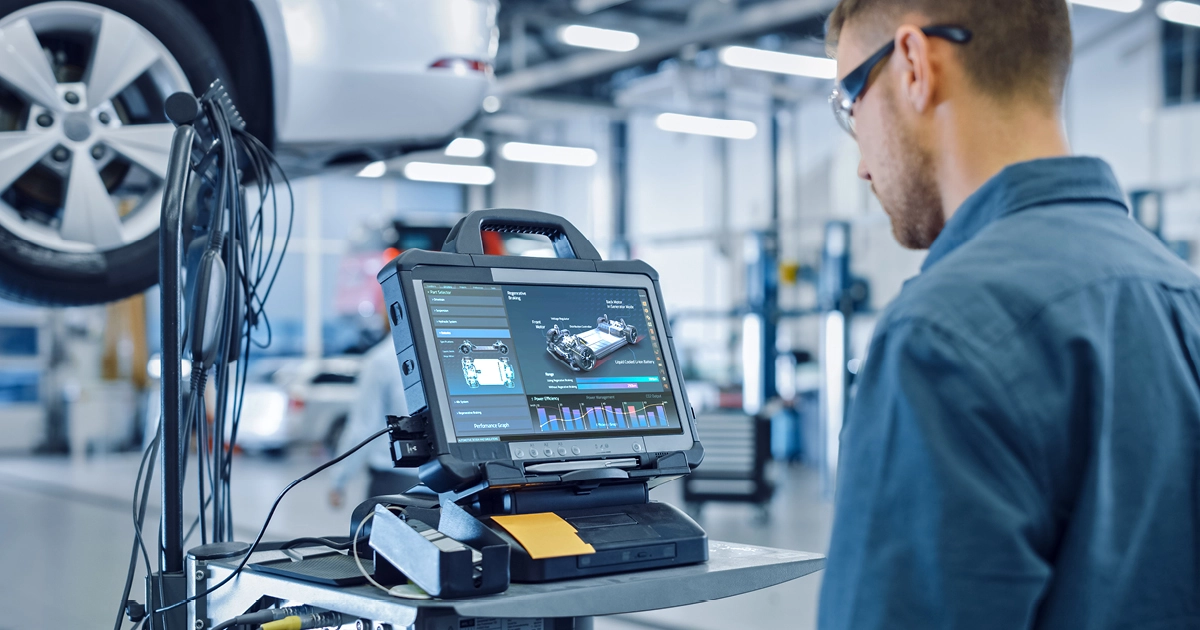
One of the key pieces of a highly trained automotive technician is the innate ability to work through a problem and repair it as quickly as possible. This intersection between the mechanical, electrical, and theory is what has made the technician’s ability sought after by shop owners. Most scan tool vendors now advertise "AI-powered diagnostics," but almost none explain what the model is doing between the DTC and the suggested fix. We are entering an era where the diagnostic "search" is being replaced by the diagnostic "inference engine." These systems are pattern-matching freeze-frame data, PID streams, and VIN against millions of closed repair orders, not reasoning about physics the way a technician does, not utilizing the base theory and visual cues to move down a diagnostic path. Understanding that distinction is the difference between using AI as a high-speed research assistant and letting you use it as a parts cannon hoping to hit the mark. As AI begins to become incorporated throughout every auto repair bay, the technician's role shifts from finding information to vetting the probabilistic outputs of a machine that is conducting pattern recognition and prediction based on past data analysis.
Reasoning vs. Inference
To understand how an AI tool can help the modern bay, we must define exactly what a Large Language Model (LLM) is doing when it "reads" a Diagnostic Trouble Code (DTC). A human technician performs Physics-Based Reasoning. When you see a P0300 (Random Misfire), you develop a list of potential areas that may cause this random misfire. As a technician you consider fuel pressure, spark duration, spark plug gap, and volumetric efficiency. You reason that if the misfire only occurs under load, it is likely a secondary ignition failure or a lean condition. You are simulating the machine in your mind.
In contrast to the way you work through a problem, an LLM performs Probabilistic Inference. Probabilistic inference refers to how the model utilizes the material it was trained to process the input and return a result (Minnick, 2026). In other words, it has "read" five million repair orders and calculated that in the sequence of (Year/Make/Model + DTC P0300 + Mileage: 120,000), the most statistically probable next tokens (units of data) in the string are "Ignition Coil" or "Spark Plugs." The AI is not calculating the physics of a misfire; it is calculating the most common outcome of a dataset. It is a high-speed calculator of "what people did last time." This may come to the proper conclusion, but it may also be way off base because the underlying physics of the failure are slightly different than the training data it was trained on. The ability to adapt to the situation is not as easily done as the human technician approaching the problem from an angle that is rooted in theory while considering the humanity of failure. Humans are good at finding the weak points of a piece of technology, using it in a way that is not intended, and breaking that technology in ways that don’t make logical sense.
Bias - When AI Becomes a "Parts Cannon"
With this statistical historical nature of the LLM, it introduces the Popularity Bias. Because LLMs are trained on historical repair data, they are inherently biased toward the most frequent failures (Abdollahpouri et al., 2021). If a specific engine family has a high failure rate for high-pressure fuel pumps, the AI will suggest that pump every time it sees a related fuel-rail pressure code, even if your specific vehicle's freeze-frame data shows a voltage drop that clearly points to a wiring harness failure. For the diagnostic specialist, the danger is that AI’s confidence can override the technician's intuition. If the AI presents a "90% Confidence Level" for a component, an apprentice/technician is likely to stop testing. As experts, we must understand that AI’s confidence is a measure of how many times that fix appeared in the training data, not how well it fits the live PIDs.
Understanding the Black Box: Using "Chain of Thought"
LLMs often suffer from the "Black Box" problem: they provide an answer without showing the math. This type of query leads to a particular answer that the AI could have hallucinated without working through the problem (LIU, 2025). This can lead the technician down a path that will not fix the vehicle and could cause them to change components that are not faulty. To fix this, we use a technique called Chain of Thought (CoT) prompting. If you ask an AI, "How do I fix a P0420 on this Ford?" you get a part name. If you instead say, "Analyze this P0420. Explain step-by-step the relationship between the upstream O2 oscillation and the downstream sensor's flat-line behavior before you suggest a part," you force the model to "reason" through its tokens.
By demanding the "Why," you can spot hallucinations. If the AI explains that the downstream sensor should be "switching rapidly" (which is the opposite of a healthy catalyst signature), you know the model has lost the thread. Probing the AI for its underlying logic allows the technician to act as a supervisor, ensuring the machine's "thinking" aligns with known theory-of-operation.
Conclusion
AI is the most powerful diagnostic assistant ever created, but it is a statistical mirror of our own history, and not a physics related thinker. If we treat it as a probabilistic engine that requires high level oversight, we can use it to narrow the diagnostic field faster than ever before. When utilizing this type of tool to help you work through a problem on the vehicle the key component is the human-in-the-loop concept. This concept is utilizing the AI LLM as a tool instead of sub-contracting out the thought process to the program. Using it along with your critical thinking skills and physics grounded decision making will put you in a new class of technician. AI tools can be a force multiplier and allow the technician to simultaneously work on multiple areas of the problem while deciphering the information quicker than they could previously. Ignoring this tool is like Horace Rackham’s quote “The horse is here to stay but the automobile is a passing fad”(Bushnell, 1922).
The MAST CDX series gives instructors materials that surpass ASE training standards. Using the Read-See-Do model, students can choose their preferred learning style. CDX offers advanced simulations and technical content to support skill development in mechanical, electrical, and software-driven repair. Their expanding library helps keep classrooms updated on industry trends. See the Light Duty Hybrid and Electric Vehicles section and the full catalog.
About the Author
Nicholas Goodnight, PhD, is an Advanced Level Certified ASE Master Automotive and Truck Technician and Instructor at Ivy Tech Community College. With over 25 years of experience, he teaches workplace skills and authors several CDX Learning Systems textbooks, including Light Duty Hybrid and Electric Vehicles (2023), Automotive Engine Performance (2020), Automotive Braking Systems (2019), and Automotive Engine Repair (2018).
References
Abdollahpouri, H., Mansoury, M., Burke, R., Mobasher, B., & Malthouse, E. (2021). User-centered evaluation of popularity bias in recommender systems. UMAP 2021 - Proceedings of the 29th ACM Conference on User Modeling, Adaptation and Personalization, 119–129. https://doi.org/10.1145/3450613.3456821
Bushnell, S. T. (1922). The truth about Henry Ford. The Reilly & Lee Co. https://hdl.handle.net/2027/mdp.39015027251639
LIU, B. (2025). Demystifying the black box: AI-enhanced logistic regression for lead scoring. Applied Intelligence, 55(7). https://doi.org/10.1007/s10489-025-06430-4
Minnick, Chris. (2026). A Developer’s Guide to Integrating Generative AI into Applications.(1st ed.) [Book]. John Wiley & Sons, Incorporated.